
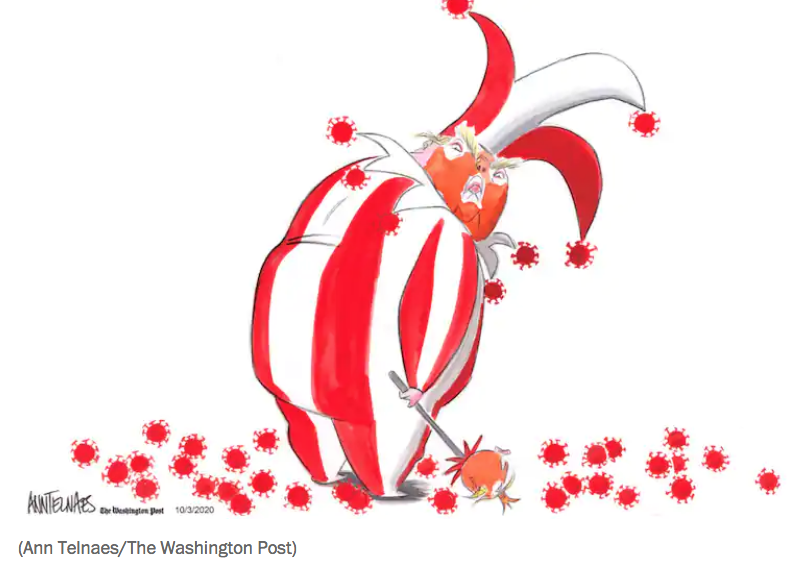
How does Trump con 72 million voters?
He gives them ‘hope’ in a swamp of meaninglessness
(3 min read)
“Religion began when the first scoundrel met the first fool.” – Voltaire
Trumpism is a religion, a belief, a cult of hope, no different than any religion (at least the few thousand outside the one we believe). Of course, worldwide, billions of people don’t ‘buy’ the Trump-con but inside the borders, “from shining sea to shining sea,” enough voters in 2016 (62.9 million) bought into the con to elect him and in 2020 it damn near happened again (72.3 million voters).
Why?
It’s simple and it’s complicated
“I was the realization of their dreams. The idol. The hero. The master and arbiter of their lives.” – Charles Ponzi [Trump sees himself the same].
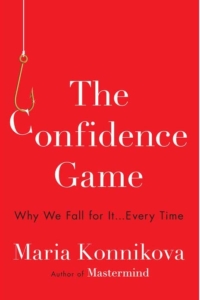 This book goes a long way to shutting down the dissonance in our minds that continually tries to explain why 30% of eligible American voters think Trump can be their “hero,” their “savior.”
The essence of every con is simple enough to highlight here and yet, it’s also complicated enough to fill a book. And there’s no better book than this New York Times bestseller, The Confidence Game by Maria Konnikova (written just before Trump’s MAGA con metastasized). She explains the ‘best’ of the infamous, from Bernie Madoff and Lance Armstrong to Jim Bakker and Charles Ponzi. How they do it. Why they’re successful. And most importantly, why ‘we’ keep falling for their cons. And make no mistake, we do.
We cannot understand 72 million people voting for Trump without also understanding the billions of dollars invested, by smart people, in Madoff’s scheme, or an entire sports world who cheered Lance Armstrong to seven consecutive Tour de France victories. Konnikova’s book is anchored in the reality that we humans are hardwired to develop belief systems that serve the primary purpose of giving us hope in a swamp of meaninglessness. Our brains have been working on it for at least a couple of hundred thousands years.
It’s not about being smart or stupid. Blind or dumb. It’s about our human need for hope, which manifests itself in a psychological and biological amalgam that cannot resist our need to believe in something, anything, that can keep us afloat above the abyss of meaninglessness.
Hope: A human imperative
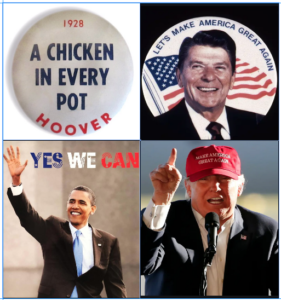
(Clockwise) Hope for food for everyone / Hope for ‘trickle-down’ economics / Hope for Black people / Hope for going backwards.
Hope for something better has elected many presidents across history: Hoover, Reagan, Obama and Trump. Note: Trump used the same damn ‘hope’ slogan as Reagan: “Make America Great Again.”
We all have and need hope. It gets us through almost everything. But it isn’t the same for everyone. Not by a long shot.
For some, hope is realized and reaffirmed, but for far too many, it’s a distant glimmer. Billions of people spend their lives climbing life’s mountain while watching too many people pass them by – most cutting in line at the top – and they see that the promises never ‘trickle down’ to their lower place on the mountain. Think of Bill Gate’s family versus George Floyd’s family. Or the Black Lives Matter movement versus the National Rifle Association’s lobby. And yet, we all keep hoping for something better.
The mirage of hope keeps most people going and when they vote they’re voting for the best chance of grabbing a small portion of eternal hope. Praying for heaven versus hell.
“Many cons flourish in the world of religious experience.” – Marie Konnikova
Hope, like heaven, is a divine force and when it becomes a belief it is not to be denied. Or explained. It is fertile ground for the con artist to create meaning amid the seemingly meaningless. As Konnikova shows, “We fall for them because it would make our lives better if the reality they proposed were indeed true. They give us a sense of purpose, of value, of direction.” Trump did this. He gave 72 million people who are lined up way down the mountain, a sense of value, direction, purpose and hope. And they bought into his confidence game.
Interestingly, Sam Harris and others have posited that Trump’s traits – seen by most as abhorrent and disgusting – actually make millions of his believers feel better. Trump’s lack of character and sins are a welcome mat for his ‘flock,’ regardless of their failings. He is filtered through a religious lens that ‘we’re all God’s children’ and accepted as we are. His appeal, his con, is no different than Jim Bakker, Jimmy Swaggart and dozens of other preachers and cons. No matter his sins, ‘we forgive him, as he forgives us. We see some of us in him.’
Hope trumps reality
Hope organizes beliefs so that they become the matrix of our life, continually reinforcing eternal hope and, as Konnikova explains, our hopes jump over the threshold of rationality to the point where we simply believe.
72 million Americans believe the con because it offers them more hope than the reality. And cons like Trump prey on the reality – the fear, anger, disillusionment, disappointment, desperation, need.
Until the reality gets better for 72 million people, the con will work.

“I was raised to know that I should never …
sacrifice a principle for personal ambition.” Who said it?
(7 minute read)
Oh, okay, that’s an easy question to answer. But inherent in the answer is a much larger question and a much Read more…
The inmates are running the asylum …
in every city hall and they keep banging their heads against the same wall, expecting a different outcome. That’s insanity!
(5 minute read)

“People are the worst”




Coming 2027

My personal history is the stuff they write books about. And that's what I am doing. The working title, "Chains of My Father: Marry White."
"The ghostly image of the tragic mulatto trapped between two worlds." - Barack Obama
This perspicacious line from the Prologue of Barack Obama's "Dream from My Father" wrenched my aspiration into action. I started writing, furiously. Unlike Obama's perspective, my pain had been for the opposite reason: I was not seen by whites as a "tragic mulatto," rather I lived every day of my childhood hoping whites were not "searching my eyes for some telltale sign" that I WAS mulatto. This is my story.
It's historical fiction because I cannot find enough records to substantiate all facets of the story. I've combed the genealogy, traveled to my father and grandparents' birthplace, walked the graveyards, searched the churches and ... well, all the facts aren't there. I've written three books based on the genealogy of other families but my ancestors emerged from a journey of too much slavery and too few records.
In Grenada, West Indies, my paternal, 3x great grandmother was a "freed slave" and my grandmother, Amelia, was born to a mixed race slave named Mary (we do not know her last name) and a white, French plantation owner, Fredric de Poullain. Amelia was raised in the "Big House" and in adulthood attempted to escape her black heritage by disowning her mother, telling her, "Get out and never come back." Amelia, the mother of twelve children, enshrined the family in her ancestors' commandment, "Marry white." Many did, including my father marrying mother a lovely, white, Anglo-Saxon protestant born in England. They met in Canada where my dad studied and became a doctor.
It has taken seven generations to be free of the stigma of black heritage but today my children embrace it. Unfortunately, the past 250 years have been a wasteland of bigotry and racism, but, on closer look, we see not only the brutality, fear and violence but the self-respect, dignity, love, perseverance and indomitable spirit.
The depth of historic perspective and the human inspiration has created a trilogy and as of this writing I have only arrived at the beginning of the 20th century. 1900 is the year my father was born and the beginning of Book III, and he's pushing me to make sure our story is published by the summer of 2027.
get social